
I recently gave the keynote at the 2026 California OER Conference. This piece is the article version of the talk After the Chatbot Era - CalOER Keynote.
I’m always fascinated by how people got into both OER and AI so here’s my story.
In 2017, I attended Digital Pedagogy Lab Vancouver, co-hosted by Hybrid Pedagogy and Kwantlen Polytechnic University, because I was trying to figure out what to do with my online American literature courses. Robin DeRosa, now Executive Director of the Open Education Network, happened to be co-leading the open pedagogy track. I hadn’t chosen that track because I didn’t know what OER was. But when someone learned that I was teaching American literature, they recommended I talk with her about her Open Anthology of American Literature.
So we chatted. She was awesome. That conversation led me to seek out a team adapting and updating the latest version through the Rebus platform. It’s there that I exchanged a few emails with Apurva Ashok, now Executive Director of the Rebus Foundation. In 2020, I joined a Rebus cohort that Apurva facilitated. In 2021, I became one of Rebus’s first three alumni facilitators, helping OER creators become leaders in OER training.
I owe a tremendous debt to Robin and Apurva for helping me enter the OER space.
My intro to AI was through the same open community. By spring 2022, I had developed, co-developed, or adapted several textbooks, including one for first-year writing. That work led to me interacting briefly with Anna Mills on Twitter. At one point, Anna posted about OpenAI’s progress on long-form prose generation. I recall a screenshot with an output that seemed very surprising to me at the time. I created an OpenAI developer account and began experimenting with GPT-3 in the OpenAI Playground. Over the next several months, OpenAI improved its post-training methods, leading to the more user-friendly GPT-3.5 model that most people now know as the original ChatGPT.
It was also Anna who introduced me to Delmar Larsen a few years ago, when X was still Twitter, as we were trying to figure out how to ground custom chatbots in OER textbook chapters.
GenAI 1.0
I treat my original experience with GPT-3 and GPT-3.5 as part of GenAI 1.0. The agentic interactions that increasingly define 2026 are fundamentally different. Until about six months ago, I occasionally used AI for OER, but the same limitations kept getting in the way. By the end of last year, and increasingly throughout 2026, almost everything I do has acquired an agentic component. (That doesn’t mean everything I write is AI-assisted. As I’ll show below, using AI to help with writing is the least interesting part of GenAI 2.0.)
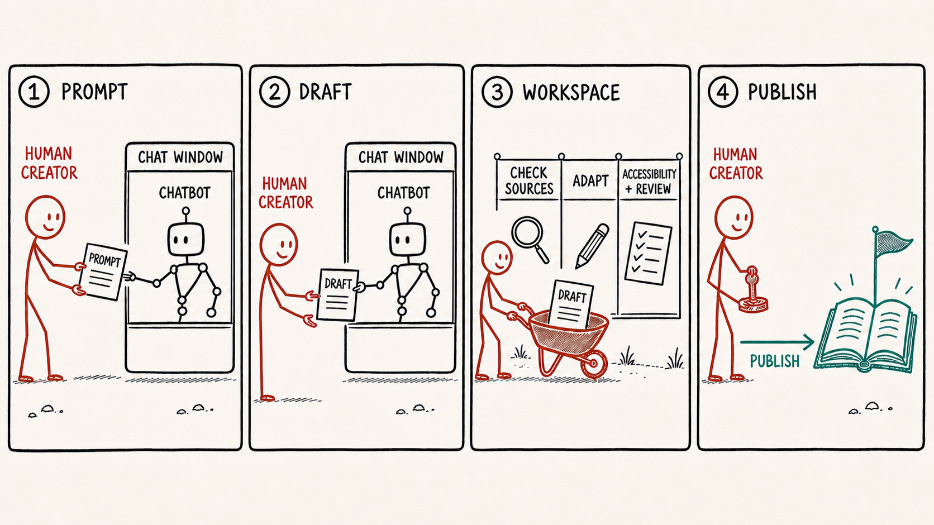
GenAI 1.0 gave many OER creators a confined chatbot interaction. We typed a prompt. The chatbot gave us an output. If we liked that output, we copied or downloaded it and carried it to our workspace, where we did the cleanup and revision before publishing. A hard boundary separated the chat interface from Google Docs, an LMS, GitHub, our OER textbook, or wherever the OER lived.
Adam Croom’s 2023 account of updating an open advertising textbook with ChatGPT captures that workflow extremely well.
Croom had adopted a 2009 Introduction to Advertising OER in 2018. By 2023, its foundational concepts remained useful, but some parts had become dated. He tested one chapter by feeding ChatGPT one section at a time. He asked it to update outdated examples while preserving material that still worked, and he requested notes explaining each change.
He evaluated the proposals and made his own tweaks before copying the finalized revisions into a public GitHub fork. The commit history preserved a record of what changed between the 2018 and 2023 editions.
Croom noted the severe limitations. ChatGPT tended to preserve outdated article citations, so Croom had to resolve them manually. It struggled with the learning objectives and repeatedly invented objectives for material that wasn’t present, even after he challenged the error.
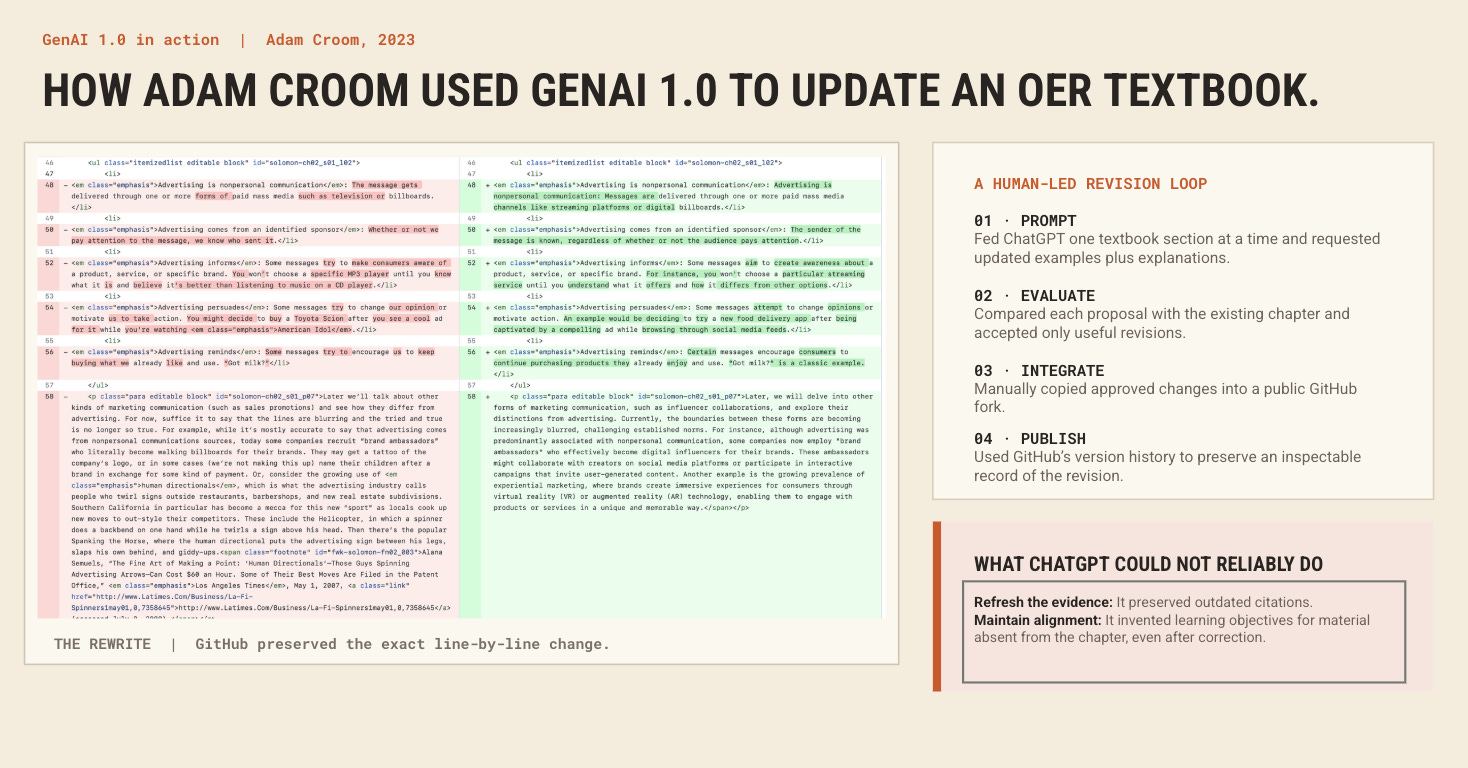
I love Croom’s article because it shows a careful, human-led revision process. He worked section by section and accepted only useful changes.
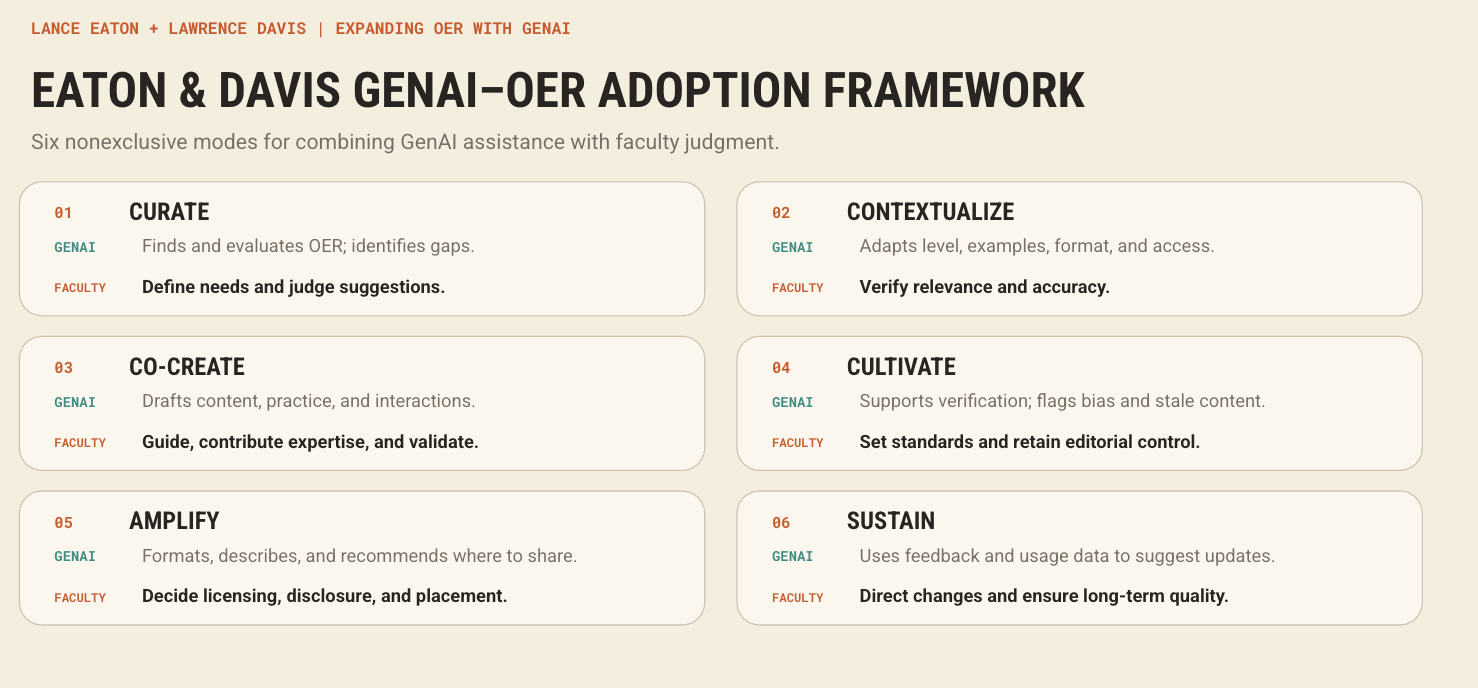
Lance Eaton and Lawrence Davis would classify Croom’s work as “cultivating” OER with GenAI, one of the six modes in their 2026 GenAI-OER Adoption Framework. Their framework includes curating, contextualizing, co-creating, cultivating, amplifying, and sustaining. It remains more than sufficient for agentic AI. What was true about faculty judgment in 2023 remains true now, but AI’s operation within each mode is changing.
Croom found that ChatGPT’s research lacked depth and hallucinated learning objectives. An OER creator can now delegate deeper searches to several subagents and assign a separate agent to check the findings for inaccuracies. The human still defines the task and judges the result. The agent can now work across the stages between those two human decisions.
GenAI 2.0. Tools and a loop
I call this GenAI 2.0 because many strategies that held until late 2025 no longer apply (although many still do).
A new wave began taking clearer form when Anthropic released computer use in late 2024, followed by OpenAI’s Operator and Anthropic’s Claude Code in early 2025. Claude Code could operate through the computer terminal, which turned out to be a powerful way to let an LLM do actual work.
By late 2025, the models were becoming reliable enough for sustained agentic work. In early 2026, Anthropic launched Cowork in its desktop app, alongside a more approachable way to use Claude Code. OpenAI launched the Codex app in February.
Instead of giving the agent a single prompt, I can now give it an entire job brief with detailed plans for how a project should be completed. I can also give it a skill, or a set of skills, that explains how to perform specific parts of the job.
Imagine that the job brief is a plan for updating a chapter in your textbook (most OER creators wouldn’t use AI for drafting, this is just an example because it’s familiar). The skills might require the agent to conduct thorough research, plan the targeted revision, cite sources properly, check for inaccuracies, remediate accessibility problems, create diagrams or tables, and prepare the finalized chapter for publication. The agent can move through all those stages in a single loop. It can delegate bounded work to other agents, inspect their outputs, check its own work, and continue until the result meets the project requirements.
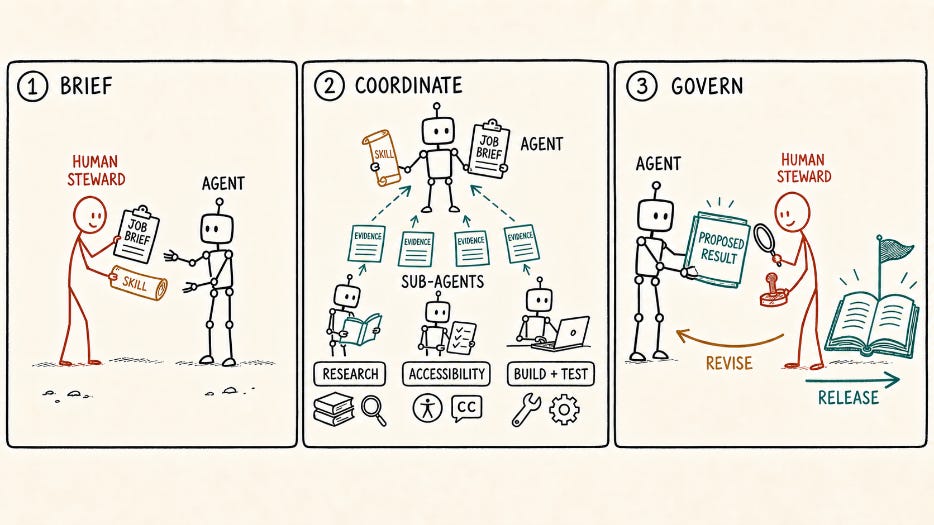
An LLM still sits at the center, but what changed is the harness around it. Frontier models can manipulate files and operate a browser or computer. They can also manage subagents. Claude Code, Cowork, and Codex are designed for this kind of looped task completion that uses tools. The model acts, observes the result, and acts again inside the permissions you have granted.
For many tasks completed on a computer, an agent can now do much of the work. If you haven’t used Codex’s computer control, it’s hard to convey what the experience is like. Whenever I run into a problem on my computer now, I often just tell Codex to fix it.
Steering Agents
OER creators can steer the loop through three basic levers.
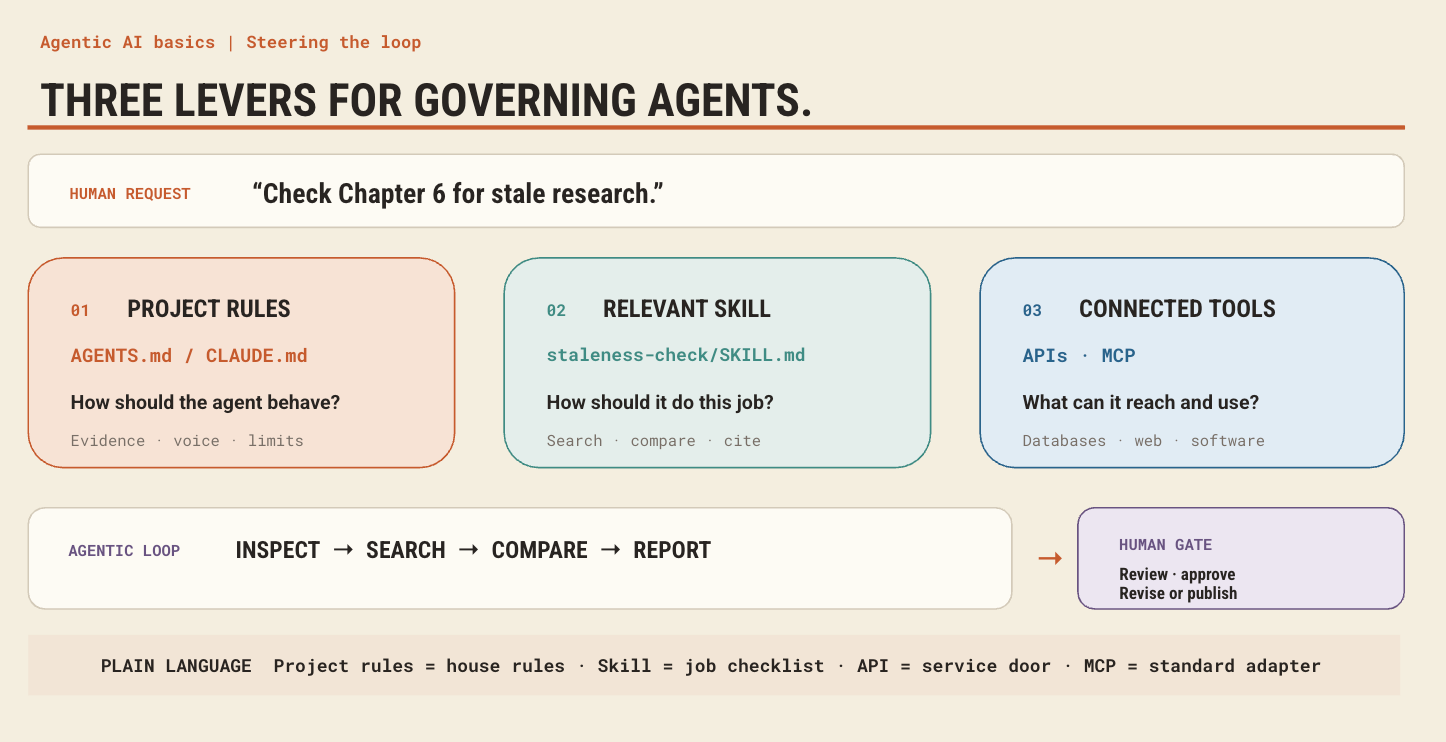
First, project instructions such as AGENTS.md or CLAUDE.md tell the agent how to behave whenever it works in a folder. If you keep an OER textbook in a folder on your computer, a project instruction file can supply the operating context and evidence rules. It can also state the publication boundaries for that textbook.
Second, a SKILL.md file tells the agent how to complete a recurring job. I might create a staleness-check skill that scans a chapter’s research and links. When I ask an agent to review the chapter, it can select the skill and follow the search and comparison process. It then preserves the relevant sources and reports what may need to change. I could also create a weekly automation that triggers the same skill.
Third, tools determine what the agent can reach. APIs allow software applications to communicate with a service. MCP, the Model Context Protocol, gives AI applications a consistent way to connect to external data sources and tools. An MCP server often wraps one or more APIs for the agent, but skills can also call APIs directly.
In plain language, project instructions are the house rules, a skill is the job checklist, an API is a particular service’s door and rulebook, and MCP is a standard adapter and directory that helps the AI application discover and use many such doors.
(One lever my talk didn’t cover is the broader context eco-system that includes your OER-related materials. All of that info also steers the model, just more indirectly than the CLAUDE.md/AGENTS.md and Skills.md files.)
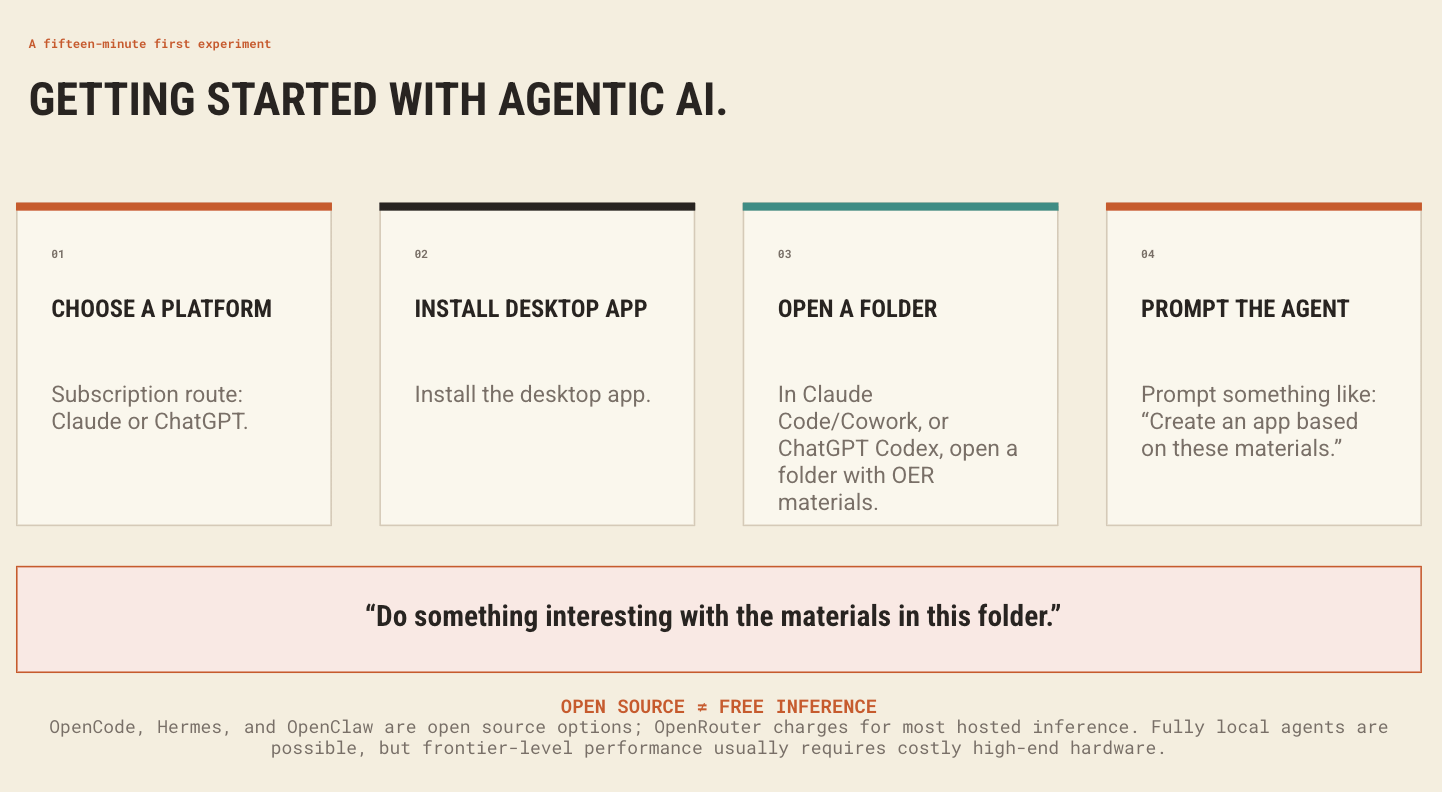
You don’t need to know any of this to run a first experiment. Install Claude or ChatGPT on your desktop, open a folder containing OER materials in Cowork, Claude Code, or Codex, and ask the agent to create something based on the materials. Open-source options such as OpenCode, Hermes, and OpenClaw also exist, although open source does not mean free inference. Using most hosted frontier models still costs money, and running comparable models locally requires expensive hardware.
Six ways OER creators are using agents
I see at least six broad categories right now: discovery and connection; creation and maintenance; transformation; companion artifacts and websites; AI-powered open learning systems; and shared agentic workflows. There are others, but these seem particularly significant for OER creators.
1. Discovery and connection
One of the most straightforward uses is managing news and social feeds, including updates from other OER creators.
Anna Mills became so frustrated with LinkedIn’s search options that she created a skill for Claude to help. The skill uses browser control to operate LinkedIn’s filters and falls back to web search when necessary.
I use agents to create a Daily Brief each morning. An automation that Claude Code and later Codex helped me build summarizes my RSS feeds and newsletters while deduplicating overlapping items. It also highlights content related to my ongoing projects. I don’t have time to click through every Substack subscription, but I want to know what’s happening in the OER and AI space and the brief has been extremely helpful.
When I find an idea on Substack or LinkedIn that I really like, I drop the link into a Codex task and ask where it might fit in a training, course, or textbook I’m developing. The agent searches the relevant project(s) and proposes a connection.
2. Maintenance
Agents can now perform a more complete version of the maintenance process Croom attempted in 2023.
I can now trigger a research skill, such as the very popular last 30 days skill, to check a chapter for outdated content. The agent reads the chapter and the skill, runs several searches in parallel, compares the findings with the current text, and gives me a report with recommended updates. It then asks whether I want to approve a revision.
It’s in this Skill.md files that we begin to see the impact of a creator’s values. When should the agent ask for review? Which sources count as reliable? Should it preserve the current wording unless the evidence requires a change? Can it edit a local file? Can it publish? Crafting a step-by-step workflow requires OER creators to decide those principles and boundaries.
Research skills can combine scholarly indexes with public search through APIs, MCP servers, or browser access. The result can be far more focused than a general Google search because the skill tells the agent which sources to prioritize and how to compare them. It also tells the agent how to filter out low-quality results.
For scholarly searches, there are new tools like Libkey, meant for academic research, where you can can use your school library credentials to access articles behind a paywall, similar to how the Google Scholar library integration works but more powerful (thanks to Alfred Wallace for this tip). There are also well-known MCPs like Paper Search.
3. Multimodal transformation
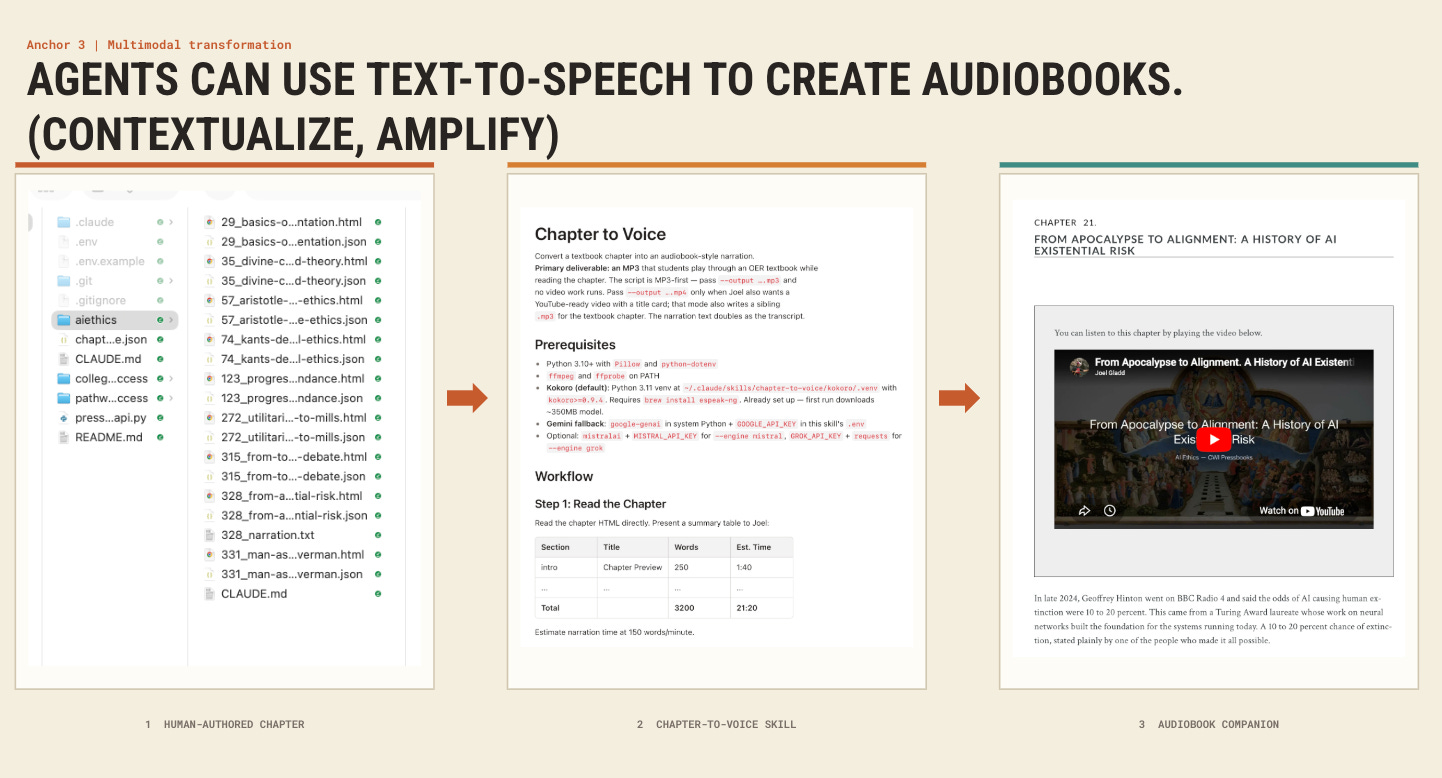
I also use agents to create audio versions of my OER textbook chapters. Students have told me that audio helps them focus while reading. Others like being able to move around or do something else while completing the course readings.
Commercial text-to-speech platforms can be expensive, so I found an open-source text-to-speech model called Kokoro that runs on my laptop. I asked Claude Code to install it and create a skill that generates audio versions of my chapters. I described the full process in “How I’m Turning My Textbook into Audio.”
The human-authored chapter remains the core OER, while the agent turns it into an audiobook companion.
4. Companion artifacts and websites
Agents can turn content creators into software creators. We can now build website companions that let students and faculty interact with OER material in ways that a static chapter cannot support.
This past year, I served as the Idaho State Board’s lead for its AI Catalyst Initiative, which focused on helping faculty across Idaho’s eight public higher-education institutions become more AI fluent. One webinar I researched heavily and co-presented covered AI, water, and energy. The information was enormously complex, and I realized the numbers would make more sense if faculty and students had an intuitive way to calculate water and energy use across the cloud technologies they use every day. I wanted something like a nutrition and calorie calculator for digital habits.
Jon Ippolito had already built What Uses More, a website that compares digital activities such as scrolling TikTok for an hour with using AI platforms like ChatGPT. He published the website under CC BY and shared the underlying data. My webinar research had already used some of that data as a starting point, so I asked Claude Code, and later Codex, to create Your Digital Life, a remix tailored to my purpose and dataset.
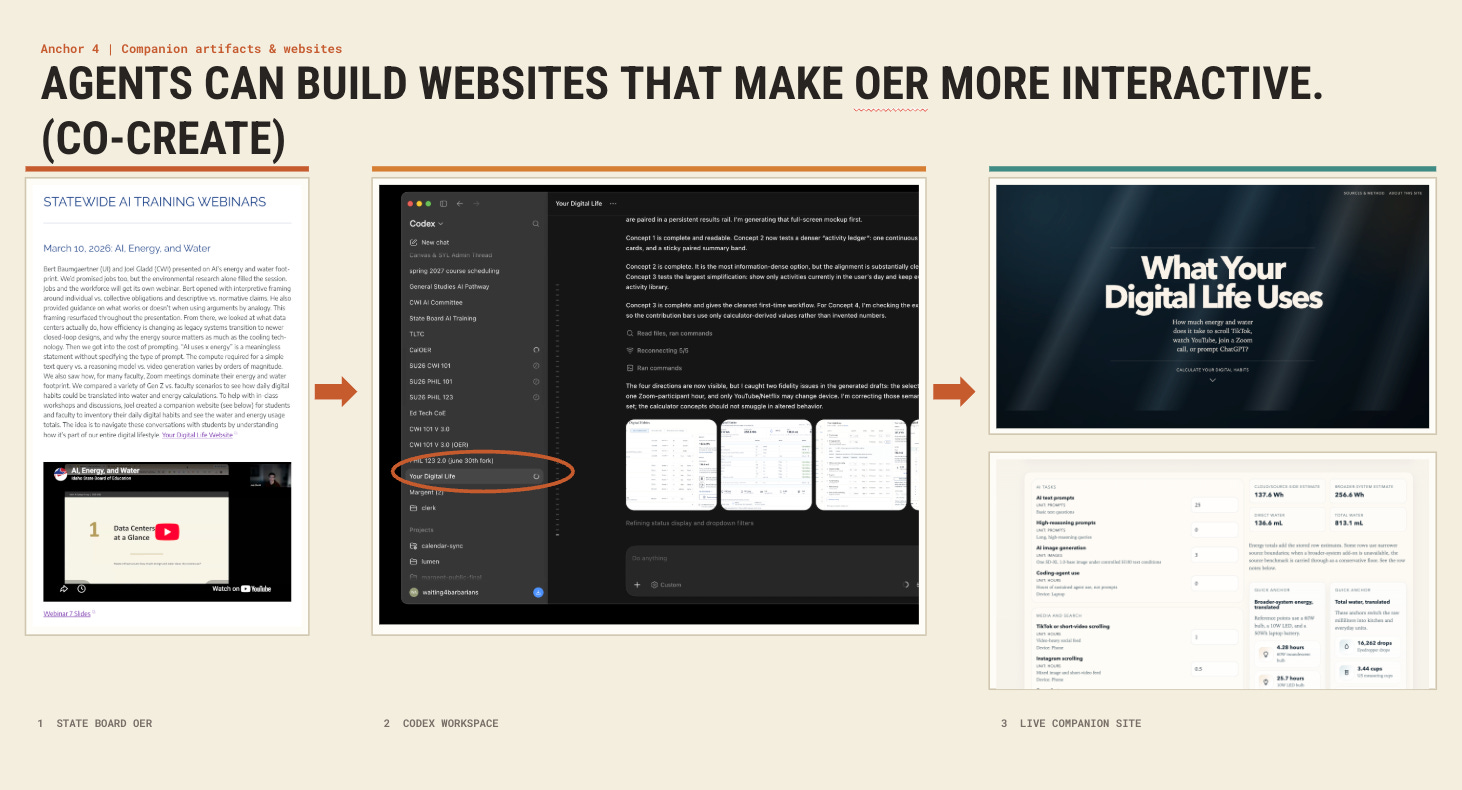
I retained the CC BY licensing and added a provenance statement to the About page. I also published the GitHub repository containing the code and sources so other people could fork the project or ask their agents to inspect the data and suggest updates.
For anyone who hasn’t vibe-coded a repository, GitHub is something like a Google Drive folder for code. It can hold the entire project. Unlike a normal Drive folder, it can preserve an inspectable history of committed changes.
I provide resources for getting started with Github at the bottom of this article.
5. AI-powered open learning systems
David Wiley’s GenOER Reader shows how Claude Code can make OER materials interact with open-source AI models locally.
The current proof of concept bundles an OpenStax textbook, builds a concept graph from the full text, and provides reading, grounded chat, practice, and other features in the browser. After the initial downloads, the language model runs on the learner’s device without a backend or account. Wiley built a working remix in about a day and released the repository for others to inspect and reuse.
This example suggests that agents can reconfigure access to entire OER catalogs and repositories.
6. Shared agentic workflows
The final category is shared methods.
I sometimes publish OER through Pressbooks. Because Pressbooks has an API, I asked Claude Code to create a command-line interface around it. The Pressbooks CLI lets an agent pull chapters to my computer, work with editable HTML and metadata outside the browser, run book-scale checks, preserve local backups, and push approved changes through the Pressbooks API.
Now I can manage a textbook locally, where agents can update accessibility and run research skills. They can also check for stale content and prepare changes for publication. Someone working with OpenStax or LibreTexts could build a similar workflow through browser control. An API makes the process smoother, but it’s not always necessary.
One note here: Something I realized from the keynote is that OpenStax, LibreTexts, or Pressbooks may have good reasons for NOT wanting OER creators to use agents in their platforms. Whether these OER platforms become agent-native, and whether that’s even desirable, is something I’m paying attention to.
The Pressbooks CLI itself is less important than the fact that the repository is openly published under an MIT license for other OER creators. We spent a lot of time during GenAI 1.0 sharing prompts. Now we need to share skills, CLIs, scripts, and the other methods agents can execute.
Agents can also erode the commons
There are many opportunities, but there are clear tradeoffs. Agents are extraordinarily good at producing volume and OER communities can be weakened by that volume when we (as creators) fail to govern it.
Scale without taste
Agents can be excellent co-creators. They are also slop machines.
By “slop,” I mean prose that is recognizably machine-generated. Careful prompting can reduce some of it, but the broader risk is lexical and conceptual homogenization across platforms.
As OER creators use agents more heavily, humanly crafted prose can become crowded out by machine-generated content. Publication speed rises before human communities develop the time, taste, or maintenance capacity needed to judge what was produced.
This is one of my biggest concerns.
Extraction without reciprocity
AI tools can also obscure contributor recognition and break the pathway back to a source.
The same skills that make agentic search powerful may reduce reliance on OER repositories and other trusted venues that connect creators with the communities and licenses behind the source. The Wikimedia Foundation faces a similar problem as people increasingly access Wikipedia content outside its core product. Chris Albon has described how AI threatens the social contract of free knowledge, and Wikimedia has introduced an attribution framework and API in response. The Wikimedia source can become invisible. Readers or agents may not know what transformation took place, and they lose the pathway back to inspect sources or become contributors.
So the problem here is that an agent can provide excellent content to a user while weakening the community that maintains it.
The agentic participation gap
Power users of Claude Code, Codex, and other agentic platforms may increasingly dominate new OER production. A small number of AI-savvy creators can coordinate many agents and publish at a pace other contributors can’t match.
In a 2026 preprint based on a randomized educational experiment, Idan and Anand found that GenAI raised average productivity but distributed the gains unevenly according to AI-interaction competence. In OER, coordination skill could compound output and visibility faster than taste and discernment. (more slop)
And then volume could become influence. Creators who care less about agents may find themselves crowded out by less discerning creators who happen to be obsessed with Claude Code.
Technical, cognitive, and intent debt
Vibe-coded websites create a subtler risk. The commons may fill with GitHub repositories and software that very few people understand, including the people who created them.
Margaret-Anne Storey and Martin Fowler distinguish among technical, cognitive, and intent debt. Technical debt accumulates when generated code, dependencies, and automations become difficult to repair or change. Cognitive debt accumulates when creators lose the mental model they need to explain a project or predict what a change will do. Intent debt accumulates when a project fails to preserve the pedagogical goals and constraints that future humans or agents will need.
Agents are building OER faster than creators can understand or maintain it. Because agents can publish open content so easily, we may see more content that remains comprehensible mainly to other machines. People who want to adapt the project will struggle to understand what the software does and how it has been maintained.
Translating CARE for the agentic era
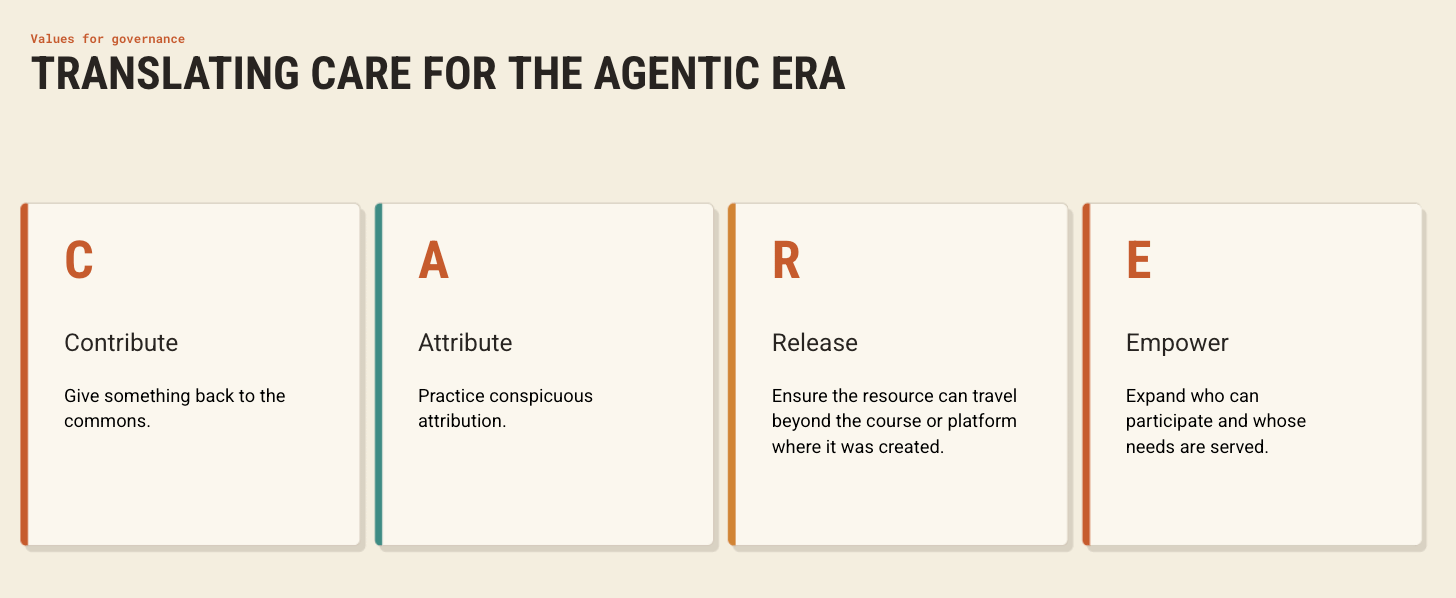
The CARE Framework, created by Lisa Petrides, Douglas Levin, and C. Edward Watson, gives OER creators a way to govern this transition. An open license is necessary for a healthy commons, but a license does not by itself sustain a community.
CARE asks open educators to Contribute, Attribute, Release, and Empower. I think each principle takes on a more specific meaning in the agentic era.
Contribute: build agent-native libraries
What new forms of contribution does this transition require?
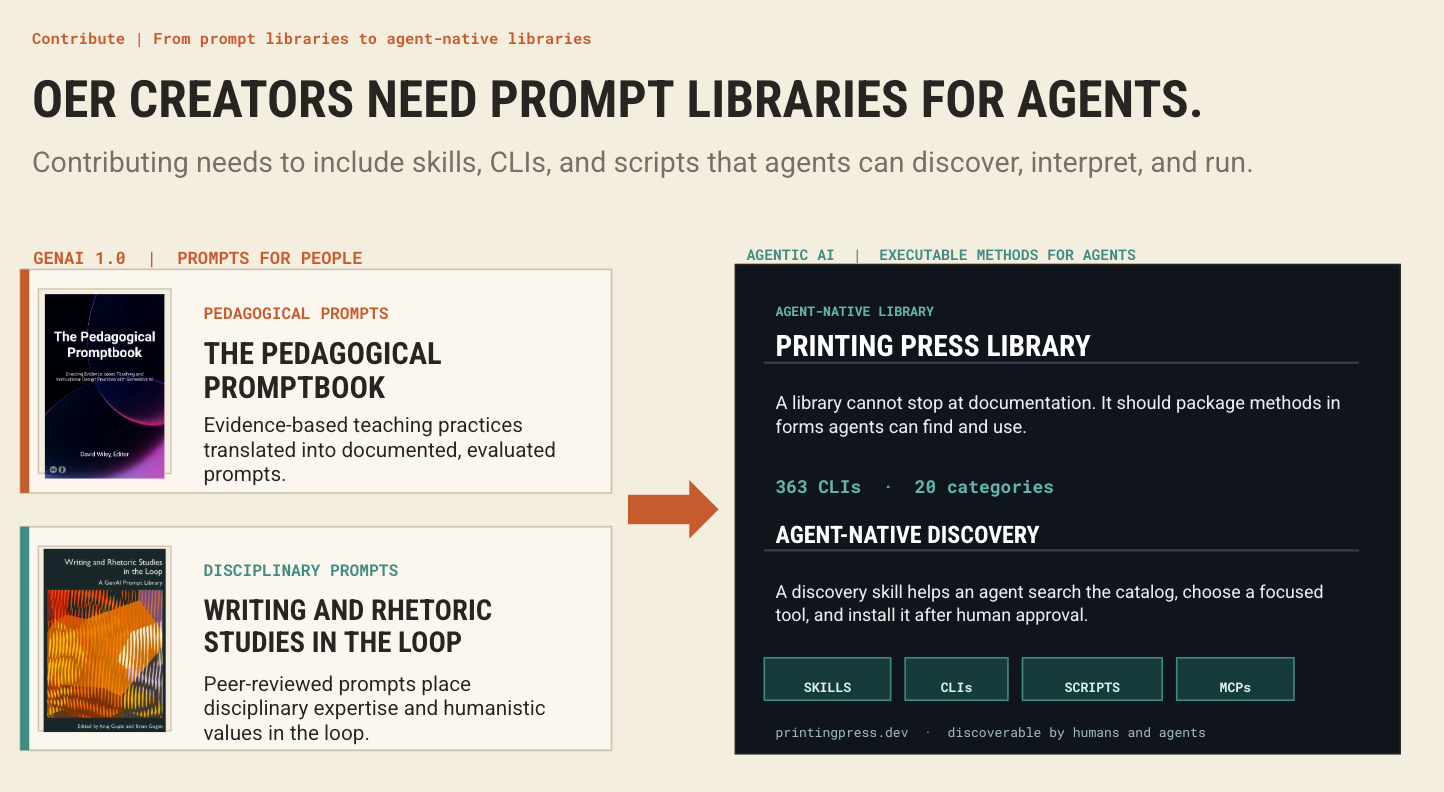
GenAI 1.0 prompt libraries have been closing the gap between everyday prompting techniques and pedagogical and disciplinary methods. David Wiley’s Pedagogical Promptbook and the WAC Clearinghouse’s Writing and Rhetoric Studies in the Loop are excellent examples. Both openly licensed guides give scholars clear pedagogical framing for prompts that support learning.
Agent-enabled OER needs open-method libraries that also include artifacts agents can discover and use: skills, CLIs, scripts, MCP servers, and related tools. The Printing Press Library is probably the closest example right now. It publishes a large catalog of skills and tools that agents can inspect and install.
An OER version would need to be useful to agents but legible to humans. It would pair executable methods with pedagogy. It would also explain how each skill supports attribution and responsible OER creation. To my knowledge, that kind of library does not exist yet.
Attribute: make authorship and stewardship visible
Authorship was already complicated in the AI era. Agents scale this problem.
Substack has begun pairing two kinds of transparency. Authors can add an optional “How I make this” statement explaining their process. Separately, readers can choose to scan eligible text published on or after Jul 21, 2026 although publishers may disable the feature. I believe that OER publishing platforms should (eventually) provide a similarly consistent place for creators to explain how AI contributed to a resource.
For this to be meaningful, disclosure statements should also appear in the textbook’s metadata. Agents need a machine-readable record, and the account needs to travel with later versions of the resource. Individual creators can publish their own disclosure or stewardship statements, but consistent placement and metadata require platform support.
Attribution should also include granular version logging. A useful version record makes three things legible: what changed, what the agent did, and which human judged and authorized the publication.
I’ve been working on a textbook for our college’s First Year Experience program to be agent-native from the ground up. Each chapter has a sidecar that tracks whether the chapter was adopted or newly created, what changed during an update, what role the agent played, and what role the human played. The logging is automated. Whenever I edit a chapter or approve an agent revision, the agent updates the version history.
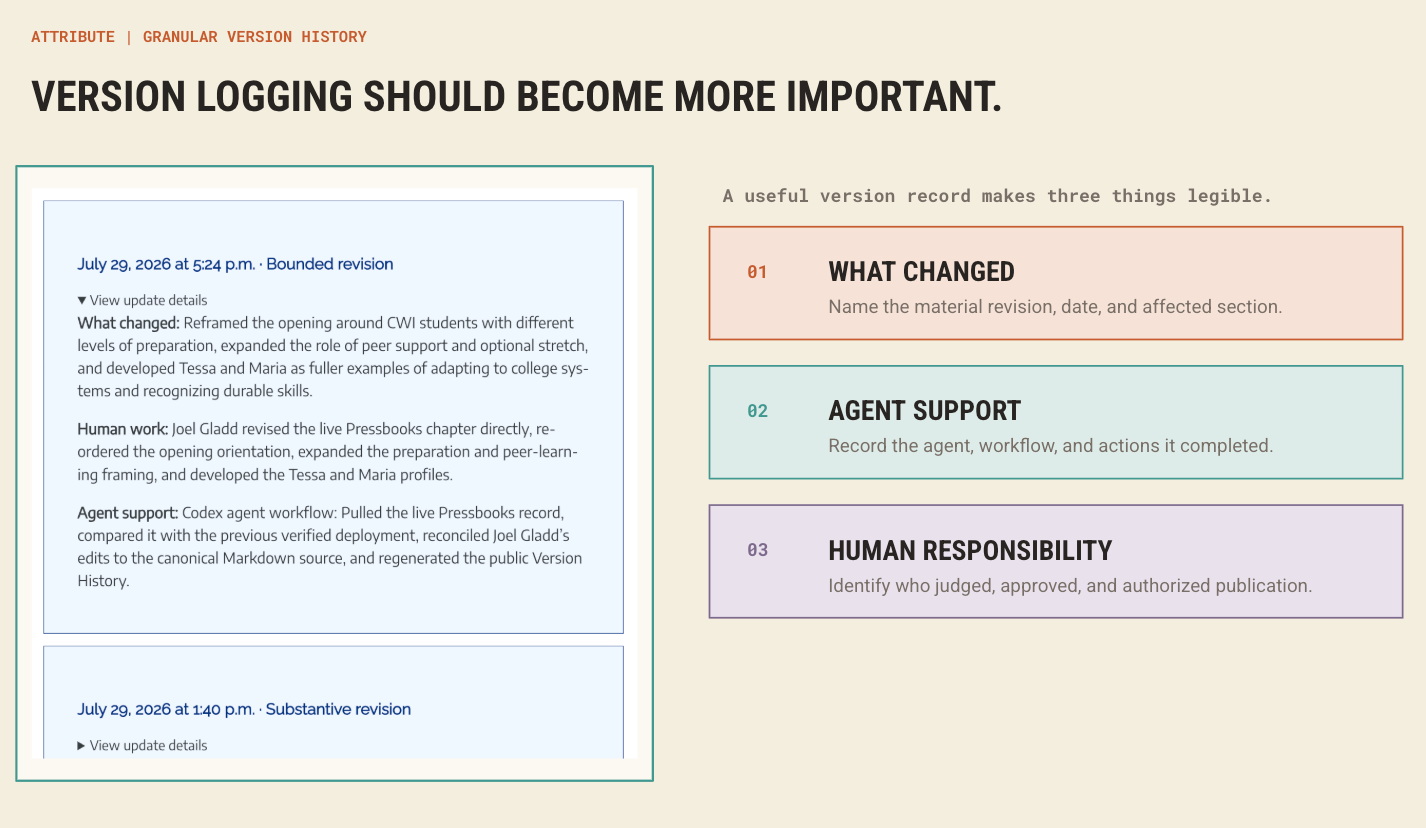
These records can help establish trust because humans and agents can inspect how an OER has been maintained. OER creators should share strategies for doing this. I believe that platform providers should eventually make the process more consistent through APIs and standard machine-readable metadata.
Release: licensing OER bundles
OER textbooks are increasingly becoming OER bundles. The core resource may now be accompanied by websites, audio, games, or interactive tools. The same bundle may include source code, datasets, and the methods needed to maintain them.
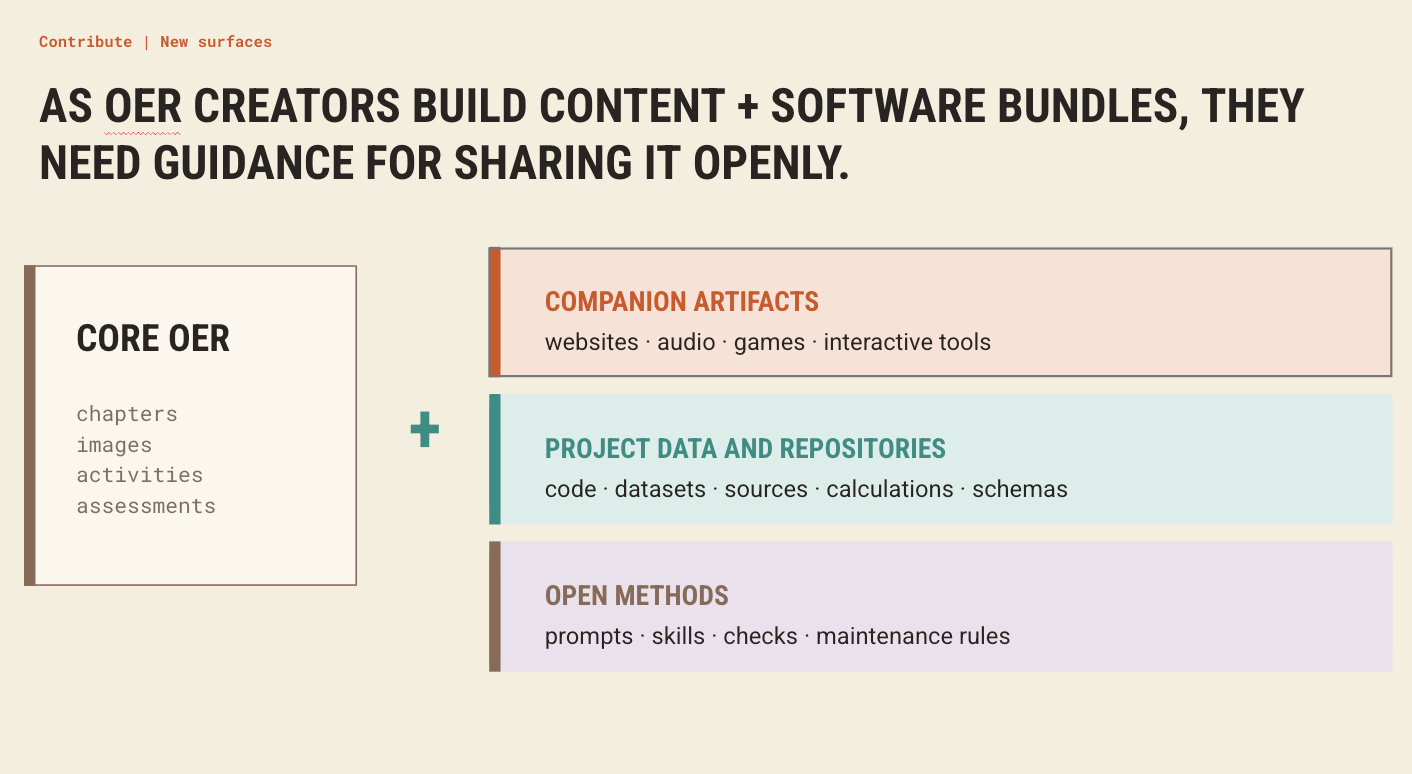
Many OER creators know how to apply a Creative Commons license to prose and images. Now we need training in how to release the software and data surrounding those materials.
Your Digital Life, for example, uses three open regimes. The prose and method use CC BY 4.0. The project data uses CC0, which is a public-domain dedication. The website code uses the MIT License.
So one OER bundle may need multiple licenses. Creative Commons licenses generally cover educational content. Data may use CC0, a CC license, or data-specific terms, depending on the rights involved and whether attribution is required. Software and executable workflows generally need software-specific licenses such as MIT, GPL, or Apache.
I’m not an expert on open licensing, and the exact stack depends on the project. But OER creators who use agents to build software bundles will need to become more comfortable with open-source licensing practices.
Empower: reduce the agentic participation gap
How do we create entry points for a range of abilities and reduce a new technical divide?
OER creators do not all need to use Claude Code or Codex!
And yet: during the past year of training faculty and staff, I’ve seen many casual AI users who want to learn agentic workflows and find the transition from a chatbot interface intimidating.
Training should treat agent readiness as a spectrum of support, not a prerequisite ladder. Some creators may only need help opening a folder and running a bounded task. Others may want to create project instructions and skills. More advanced users may need security and GitHub support. They may later work with APIs, MCP, machine-readable metadata, or mixed licensing.
GitHub may be the lowest-hanging fruit. For OER creators who want to use agents, basic familiarity with repositories and version control is one of the largest practical levers available. It gives creators a way to share code and skills and inspect changes. GitHub also supports collaboration and preserves a public record.
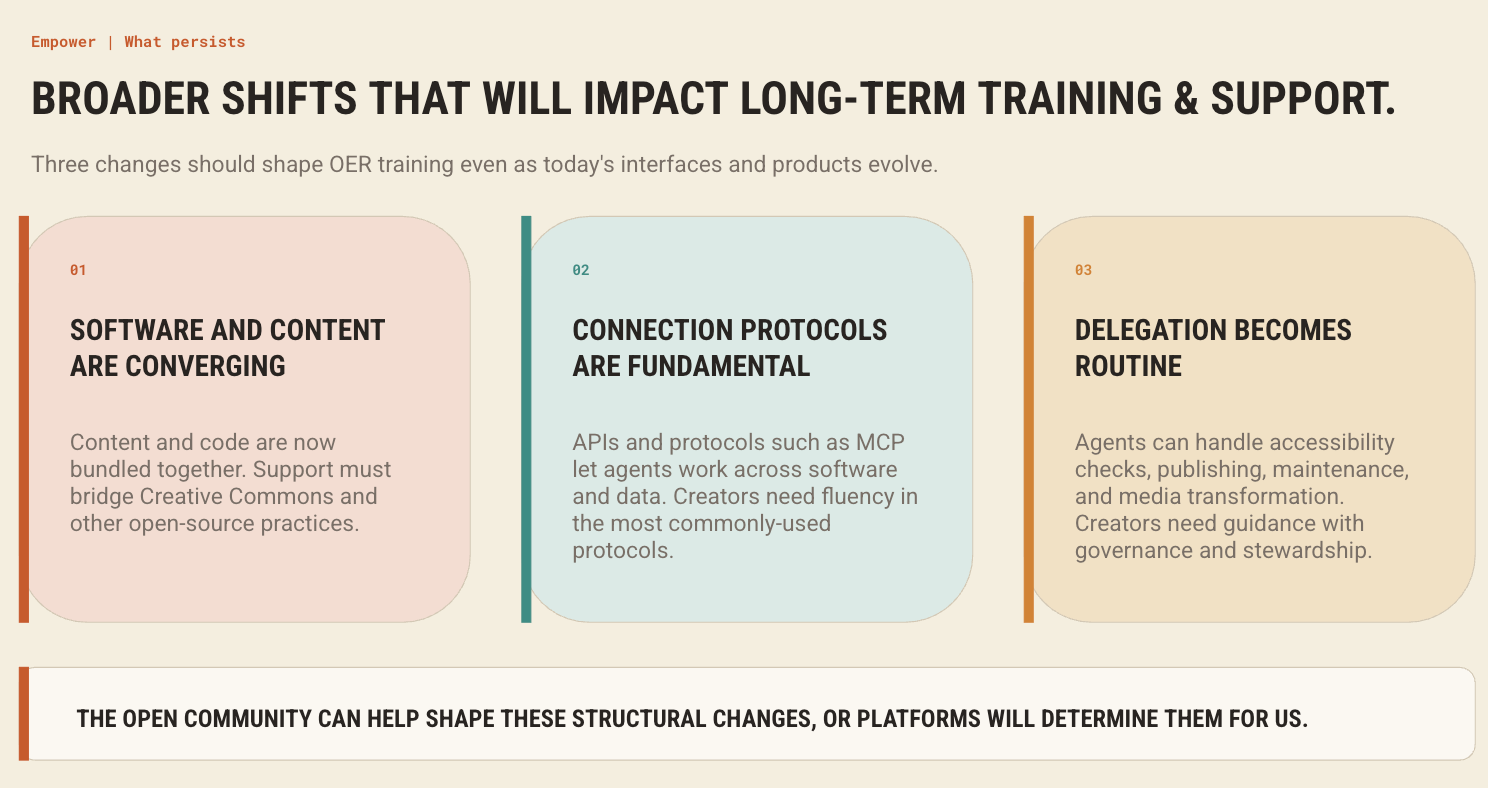
Open practices are converging because OER creators now work with content, code, and data in the same project. Protocols such as APIs and MCP are becoming a basic form of technical literacy because they let agents work across software and data. Delegation is becoming routine because agents can handle accessibility checks and publishing. As mentioned above, they can also help with maintenance, research, or media transformation.
OER training will need to help creators govern those loops.
This is a great time to create!
I hope I’ve conveyed at least a sliver of the enthusiasm I have for what’s happening right now. There are serious risks, and we’re all greatly annoyed by the amount of slop coming at us from every direction.
Still, I firmly believe that if you have good ideas and you’re willing to learn and explore, this is the best time to be an OER creator.
Resources for GitHub and agent-assisted research
These are the resources I included at the end of the keynote. The first group is for OER creators who want a practical introduction to GitHub. The second collects agent-ready research skills and MCP servers.
GitHub and version control
Git for Humans: A friendly mental model for commits, branches, remotes, and history.
Software Carpentry: Version Control with Git: A workshop path through shared work, licensing, citation, and collaboration.
GitHub Skills: Guided exercises for repositories, issues, pull requests, and GitHub Pages.
Faculty GitHub discussion: Recommendations from Steel Wagstaff, Ryan Randall, Bryan Krouse, Randy Hinrichs, and Jon Ippolito.
A useful first exercise is to publish one bounded OER artifact with an agent, then inspect the commits and changed files. That gives you a concrete way to learn how repositories, diffs, and version history work.
Research skills and MCPs
Scientific Agent Skills: A broad library of reusable scientific workflows, literature-synthesis methods, and citation tools.
Paper Search MCP: Search and retrieve papers across arXiv, PubMed, OpenAlex, Semantic Scholar, Crossref, and other scholarly indexes.
arXiv MCP Server: Search arXiv, inspect papers and source sections, follow citations, and maintain alerts.
AI2 Asta Scientific Corpus Tool: Semantic Scholar search, citation graphs, author records, and date-bounded discovery.
Last 30 Days Skill: Scan recent public sources and arXiv for emerging work and people. Verify the results against scholarly evidence before relying on them.